Skip to content
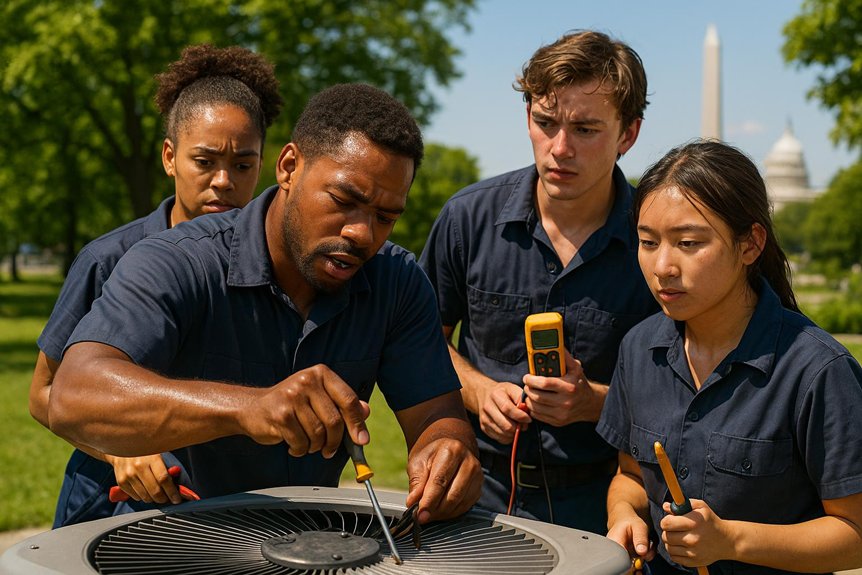
If becoming an HVAC technician is on your mind, here is a tip most people never think about: when you start your training matters. Begin in summer and you step into the busiest, most exciting stretch of the year across the DC, Maryland, and Virginia region. Instead of learning from a quiet textbook, you learn while the whole trade is moving fast, and that is the best way to learn a hands-on skill.
You do not need any experience to begin, just the decision to start. Summer is when air conditioners fail, phones ring nonstop, and skilled techs are worth their weight in gold. Train now and you build real skills quickly, then finish ready to work. Here are five reasons not to wait until fall to begin HVAC training in the DMV.
Why Summer Is the Busiest Season for HVAC in the DMV

When temperatures climb into the upper 80s and 90s and the humidity rolls in, the entire region leans on its air conditioning. Aging DC rowhouse systems break down, while offices, hospitals, schools, and data centers cannot afford a single hour of downtime. That pressure turns summer into peak season, and it is exactly why the technicians who can fix it become so valuable.
- Heat in the upper 80s and 90s pushes AC systems to their limits every day.
- Older DC rowhouse units fail constantly under back-to-back hot afternoons.
- Offices, hospitals, and federal buildings demand cooling with zero downtime.
- Data centers and schools call in urgent service the moment something slips.
- High humidity adds load, so systems run longer and break down more often.
- Demand outpaces available technicians, so every trained hand is needed.
All that activity is rough on overworked AC units, but it is a gift for someone learning the trade. A busy season means more to see, more to do, and more real problems to learn from than any slow winter month could offer. For you as a student, that advantage starts with hands-on practice.
Reason 1: You Learn on Real Demand, Not Just Theory
Start your training in summer and you are not just reading about cooling failures, you are watching them happen in real time. Instructors troubleshoot live problems, and lessons spill out of the classroom into the kind of work local techs face every day. Learning against real demand makes the concepts stick in a way a textbook never can.
- Live Problems: See real AC failures unfold instead of imagining them on paper.
- Current Equipment: Learn on the systems actually running in DMV homes and businesses.
- Real Diagnostics: Get your hands on the meters and gauges techs use in the field.
- Faster Recall: Skills you learn under real conditions stay with you far longer.
- Context That Sticks: Tie each lesson to a problem you have actually watched happen.
- Built-In Motivation: Seeing the stakes up close keeps you curious and engaged.
Watching real problems is powerful, but doing the work yourself is where your skill truly takes root. The summer rush gives you far more chances to get your hands on equipment than any other time of year, and that volume of practice is the second big reason to start now.
Reason 2: More Hands-On Practice Than Any Other Season

Skill in this HVAC trade comes from repetition, and summer delivers it. With so much equipment running and failing, you get more chances to wire a circuit, check a charge, and trace a fault than you ever would in a slow season. A hands-on HVAC school in Washington, DC turns that busy season into reps you can feel adding up.
- More running systems mean more real scenarios for you to practice on each week.
- Repetition builds the muscle memory that employers expect on day one.
- You apply what you learned in class right away, while it is still fresh.
- Seasoned instructors give you on-the-spot feedback as you work.
- You see a wide range of failures, not just one or two common ones.
- Confidence grows fast when you fix real problems with your own hands.
All that practice does more than build skill. It builds timing. A program you start in summer wraps up right as employers scramble to staff for the next wave of demand, which sets up the third reason the season works in your favor.
Reason 3: You Finish Ready Just as Employers Are Hiring
Timing is quietly one of the biggest advantages of a summer start. A focused program like the 10-week Universal Technician course can have you certification-ready in a matter of months, not years. Finish during or just after peak season and you walk into a job market where companies are actively hunting for new, ready-to-work techs like you.
- Short Runway: A 10-week program gets you job-ready in months, not years.
- Hot Job Market: Employers staff up hardest during and right after peak summer.
- Fresh Skills: You apply for jobs while your training is still sharp in your hands.
- Real Stories: Recent hands-on work gives you something concrete to talk about.
- Less Competition: You beat the fall crowd of trainees still finishing up.
- Real Momentum: You move from classroom to career without a long, skill-dulling gap.
Finishing at the right moment opens the door, but it is how fast you grow during summer that makes you worth hiring. The intensity of the season does something a quieter term cannot, and that quick progress is the fourth reason to start while the heat is on.
Reason 4: Intense Conditions Build Your Skills Faster

There is no faster teacher than a real problem in real heat. Because summer brings a constant stream of service scenarios, you are immersed in troubleshooting, diagnostics, and repairs day after day. That intensity packs months of slow-season learning into weeks, and it builds the jobsite instincts that only come from working when the pressure is genuinely on.
- Daily exposure to real problems speeds up how fast your skills become automatic.
- Working beside seasoned techs gives you constant, practical feedback.
- A wide variety of failures in one season broadens your experience quickly.
- Real urgency teaches you to prioritize and stay calm under pressure.
- You learn to work cleanly and safely even when the clock is running.
- Your mistakes in a training setting become lessons, not expensive callbacks.
That fast growth does not just make you a better student, it changes how employers see you on paper. By the time you are job hunting, the summer you spent training becomes the strongest line on your resume, which is the fifth and final reason to begin now.
Reason 5: Summer Experience Makes Your Resume Stand Out
When a hiring manager compares two new techs, the one who trained through peak season stands out. You can speak to real repairs, real customers, and real pressure, not just coursework. That experience tells an employer you are ready to contribute quickly, which is exactly what local companies want when they are buried in summer service calls.
| Where You Start | What Summer Training Builds | Where It Leads |
|---|---|---|
| Unsure of your path | Real hands-on experience | Confidence in interviews |
| Easy to overlook | In-demand, current skills | Offers from local employers |
| Stuck in a dead-end job | Industry connections | Room to advance |
| Eager but brand new | Real problem-solving practice | Faster professional growth |
| Hoping for stability | Proof you can do the work | Long-term job security |
Any one of these reasons is a solid case for starting now, and together they make summer the clear winner. What turns the season’s advantage into an actual career, though, is the program behind it. The right school gives you the structure, the lab time, and the support to make every one of these reasons pay off.
Why Choose Su’Coy CLC for HVAC Training in the DMV

Starting HVAC training during the summer gives you a unique advantage. As cooling systems work their hardest, students gain exposure to real-world HVAC concepts, common service issues, and the busy season that drives demand across the industry. Instead of waiting for the perfect time to begin, summer allows you to start building skills while employers are actively looking for qualified technicians.
At Su’Coy CLC, students receive hands-on training designed to prepare them for entry-level opportunities in the HVAC field. Our instructors combine classroom instruction with practical experience, helping students develop the technical knowledge and confidence needed to succeed in a growing trade.
If you’re ready to take the first step toward a rewarding career, our HVAC Universal Technician Training Program provides the hands-on education, industry-focused curriculum, and career support needed to help you move from training to employment. Enroll today and start building the skills that can open doors to long-term opportunities throughout the DMV.