Skip to content
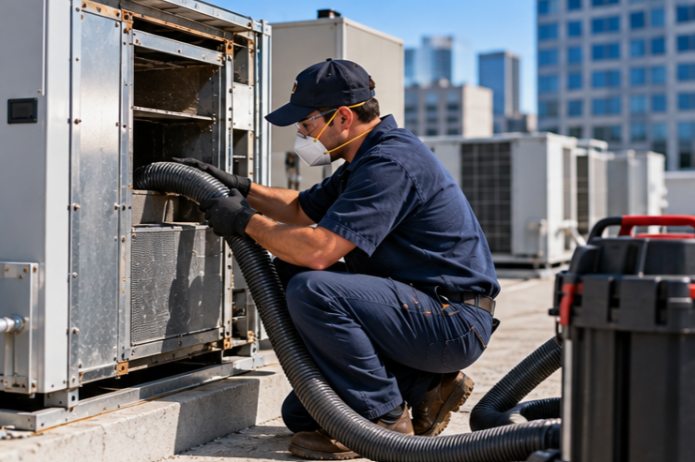
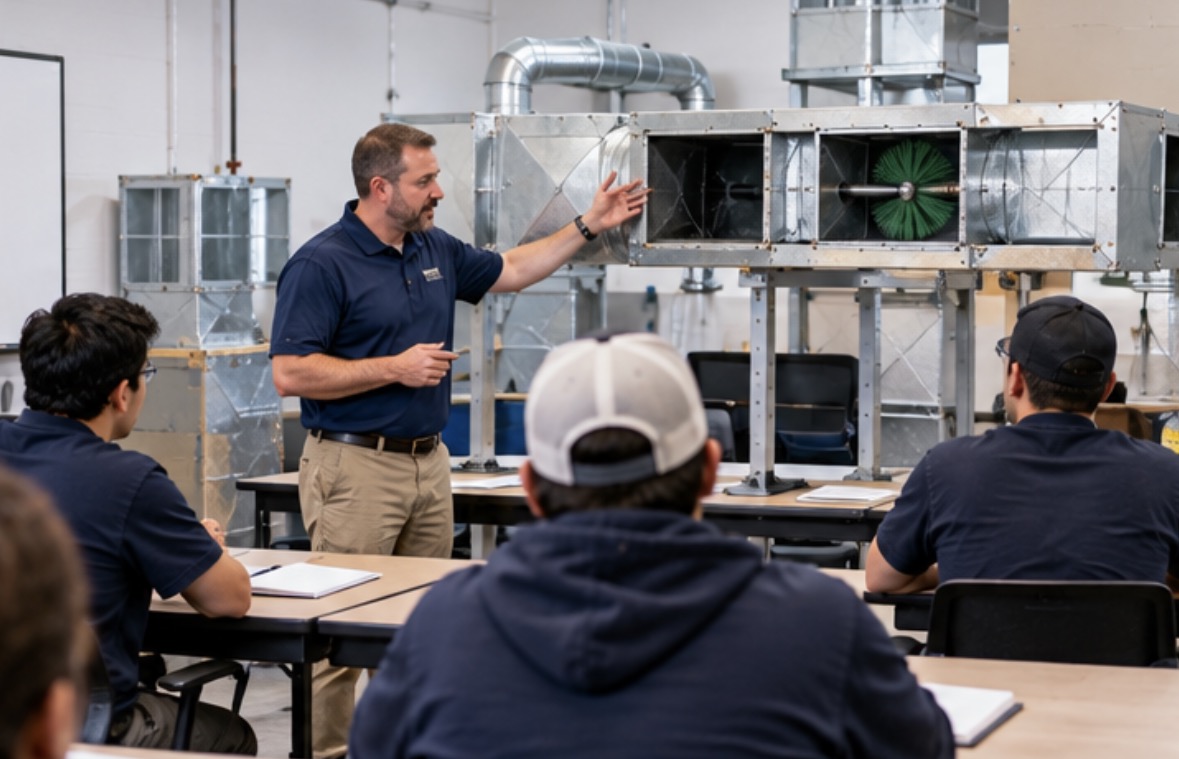
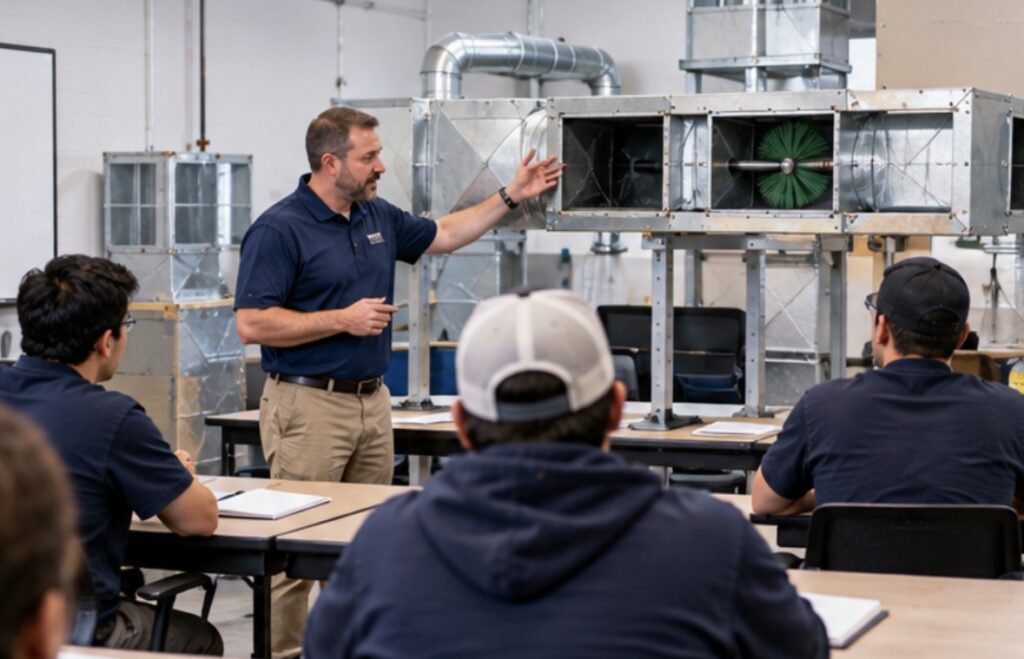
If you are training to become an HVAC technician, residential duct cleaning can give you a solid foundation, but large commercial buildings introduce challenges you may not encounter in a home. A school, office, medical facility, or multi-story building can have multiple air-handling systems, rooftop units, large trunk lines, VAV boxes, and occupied areas that require careful coordination.
The basic cleaning principles remain familiar, but commercial work demands more than knowing how to operate a negative air machine. You also need to understand system scale, equipment requirements, building access, job planning, documentation, and how to work around property managers and building occupants. This guide explains what changes on commercial jobs, which residential skills transfer, and when dedicated commercial duct-cleaning training can help prepare you for larger projects.
Can Residential HVAC Experience Prepare You for Commercial Duct Cleaning?
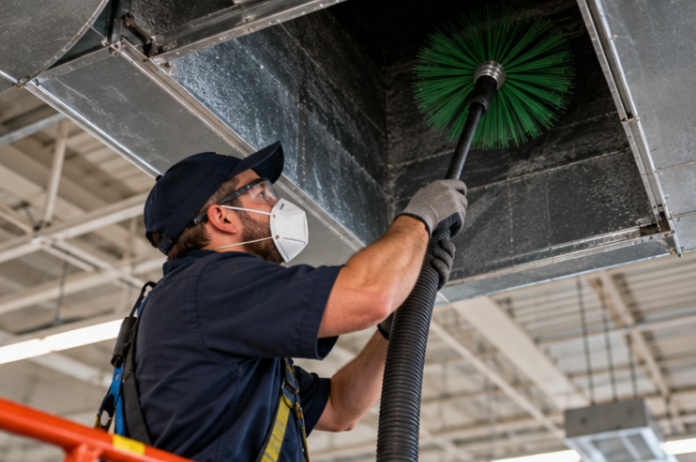
Partly, and it is worth being precise about which parts. If you can set up negative pressure correctly, cut and seal access points, agitate a duct run with a rotary brush and verify your own work afterward, those skills transfer to any system regardless of how large it is. The physics do not change with square footage.
What does not transfer is scale management. Estimating a house takes ten minutes of looking around. Estimating a building takes a walkthrough, a system count, and an honest calculation of how long each run will take with the equipment you actually own. Technicians who price a commercial job using residential instincts underbid it, and they usually find out around day three.
The fair summary is that residential experience gets you roughly two thirds of the way. The remaining third is commercial specific, and it is the part that decides whether the contract makes money. A program covering both sides together closes that gap without making you sit through material you already know.
What Is Actually Different About Large Commercial Buildings?
The building is the difference, not the ductwork inside it. A house has one air handler, one homeowner and a schedule that bends around you. A commercial property has several systems, a chain of people who control access, and tenants who cannot be disrupted between 8:00 AM and 6:00 PM.
Those differences show up in concrete ways on site:
- Several rooftop or mechanical room units serving separate zones
- Trunk lines and plenums at a scale hand tools were never built for
- Occupied floors that limit when you are allowed to run equipment
- Ceiling grids, roof hatches and secured areas that control your route
- A property manager, and sometimes a building engineer, to coordinate with
- Written documentation expected at the end rather than a verbal summary
None of those are technique problems. They are planning problems, and planning is where a first commercial job usually goes wrong.
What Equipment and Systems Will You Encounter?
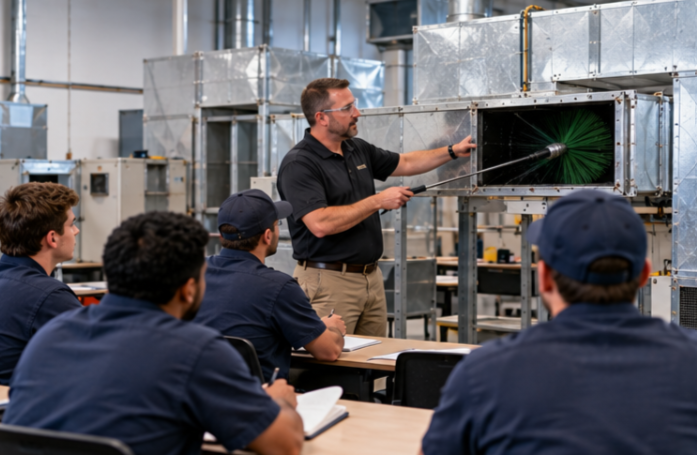
Two things change here. The building’s equipment is unfamiliar, and your own equipment may not be adequate. Both are worth settling before you quote rather than discovering mid job.
On the building side, commercial properties use configurations you will rarely meet in a home. Each one affects your access, your hours on site and your price.
Commercial Systems and What Each One Changes for You
| System or Component | What It Changes for You |
|---|---|
| Rooftop units | Roof access, ladder or lift work, and weather dependence |
| Air handling units in mechanical rooms | Larger cabinets, more internal surface area, longer service time |
| Main trunk lines | Large enough to require interior access rather than brushes alone |
| VAV boxes and zone dampers | More components to clean and more places debris collects |
| Return plenums above ceilings | Ceiling tile removal and work over occupied space |
| Exhaust and makeup air systems | Separate systems that quotes routinely miss entirely |
On your side, a portable residential setup will struggle on a building. Larger systems need more vacuum capacity, longer hose runs and enough HEPA filtration to handle the volume of air you are moving. Commercial work has an equipment threshold, and knowing where yours sits is what stops you promising a result your kit cannot deliver.
What Skills Do You Need Beyond Basic HVAC Knowledge?
Technical ability is the entry requirement, not the job. Four skills separate a technician who can clean a commercial system from one a building owner will hire a second time, and none of them appear on a residential route.
Counting and Estimating a Multi System Building
The walkthrough is the most valuable hour of a commercial job. You count units, measure trunk runs, identify what is genuinely accessible, and convert all of it into labor hours before you put a number on paper. Getting this wrong is the most common way commercial work loses money.
Coordinating With Property Managers and Building Engineers
The property manager controls your access, your working hours and often when you get paid. Knowing what to ask for, who signs off and how the building actually operates belongs before you load a truck, not on the morning you arrive.
Working Safely Around Occupied Space
Ceiling work over desks, roof access in weather and equipment running through corridors all carry risk a basement never did. Protecting the space, sequencing the work and keeping a tenant’s floor usable are part of the trade at this scale.
Reporting the Work in Writing
Building owners expect a record. Before and after photographs, a system by system account of what was done, and a clear note of anything you could not address are what justify a commercial invoice and what get you invited back.
Notice that only one of those four is a hands-on skill. That balance is the real difference between the two sides of the trade.
Why Do Commercial Jobs Require More Planning and Documentation?
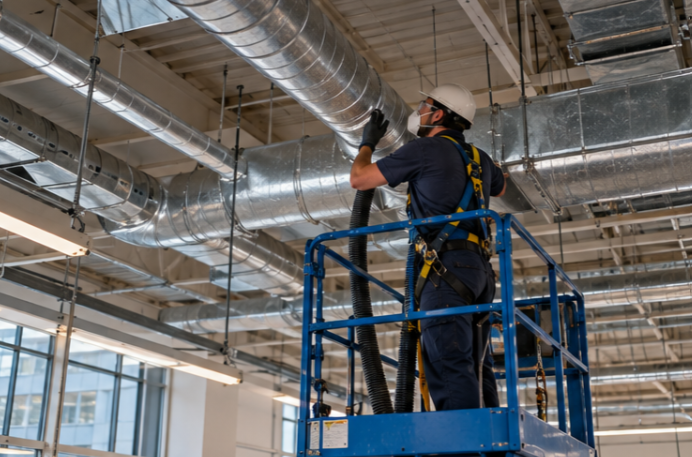
Because more people are accountable for the outcome. A homeowner decides for themselves whether they are satisfied. In a commercial building, the person who hired you may have to justify the expense to an owner, to a tenant who complained, or to an insurer.
That changes what you produce. Documentation is not administrative overhead on these jobs, it is part of the deliverable, and it is frequently the reason the work was commissioned in the first place. Planning carries the same weight for a different reason, which is that the costs attached to a commercial job are larger and several of them do not exist in residential work at all.
- Labor hours across multiple systems rather than a single unit
- After-hours or weekend premiums for occupied buildings
- Access equipment, lifts or roof arrangements where required
- Crew size, since most commercial jobs need more than one person
- Documentation and reporting time after the physical work ends
- Payment terms of thirty to sixty days rather than a check on completion
That last line catches people out. You may finish a job in March and see the money in May, which means enough working capital to carry the wages in between. Job costing and margin protection are taught as part of structured duct cleaning training precisely because technical skill on its own does not make the work pay.
Do You Need Training Before Taking On Commercial Duct Cleaning Work?
No state rule forces you into a classroom, so the honest answer is that it depends on what you are willing to learn at a client’s expense. You can work commercial out by underbidding a few buildings and absorbing the losses, and plenty of operators did exactly that.
The argument for training is simply that it is cheaper. One badly estimated building can cost more than a full program, and it can also cost you the property manager who would have handed over the rest of their portfolio.
Training gives you something to point at as well. When a facilities manager asks how you work, being able to say your method follows the NADCA ACR Standard is a different conversation from saying you have done a lot of houses. The standard is the reference commercial buyers actually recognize, and on a large building they may want evidence the work met it.
What Should You Look For in Commercial Duct Cleaning Training?
Not every program that mentions commercial work genuinely teaches it. Before paying for anything, these are the questions worth putting to a provider directly.
- How much of the course is hands-on with real equipment rather than classroom time
- Whether you will personally run a negative air machine or only watch one running
- Which standard the curriculum is built around
- Whether commercial access and coordination is taught as its own subject
- Whether job costing, pricing and margin are covered or quietly left out
- Exactly what document you receive at the end and what it represents
The last one deserves particular attention. A certificate of completion documents the training you did, which is genuinely useful, but it is not a state license and it is not a NADCA certification. Any program blurring those three things together is not being straight with you, and that alone tells you what the rest of the course will be worth.
Residential or Commercial: How Do the Two Compare?
Residential and commercial duct cleaning use many of the same core techniques, but the working environment changes significantly as building size and system complexity increase. Comparing the two helps aspiring HVAC technicians understand which skills transfer directly and where commercial projects require additional training, equipment, planning, and coordination.
| Factor | Residential Work | Commercial Work |
|---|---|---|
| Systems per job | One air handler and its runs | Several units, often across zones |
| Scheduling | Daytime, homeowner present | After hours or phased around tenants |
| Equipment needed | Portable negative air setup | Higher capacity, longer runs, access gear |
| Documentation | Usually informal | Written report expected by the owner |
| Payment | Typically on completion | Often thirty to sixty day terms |
Read across the rows and the pattern is consistent. Commercial work rewards planning and paperwork as heavily as it rewards technique, which is exactly why it is trained as a separate discipline rather than picked up as you go.
Why Choose Su’Coy CLC for Commercial Duct Cleaning Training in Temple Hills, MD
The program worth your money is the one that teaches both sides, because most technicians end up working across both and the skills compound rather than compete.
Su’Coy CLC runs a Commercial and Residential Duct Cleaning Class covering both in a single six-day course at 4584 Beech Rd in Temple Hills, Maryland. The curriculum is built around the NADCA ACR Standard and includes negative air machine operation, duct sealing and basic repair, mold recognition protocols, and commercial building access and coordination.
It also covers the business side that decides whether commercial work is profitable, including job costing, profit margins, client walkthroughs and building a recurring client base. Sessions run 10:00 AM to 2:00 PM Monday through Saturday, tuition is $1,500 for the full program, and the training is entirely hands-on with real equipment. No prior HVAC license is required to enroll, and graduates receive a Su’Coy CLC Certificate of Completion, which documents your training rather than serving as a state license or a NADCA certification.
If you are weighing whether to take on larger buildings, review what the class covers and call (301) 901-7732 to talk through where you are starting from.